
I came to Baroda in 1969 to study architecture. It was a five year course at the Department of Architecture, M S University of Baroda which was among the top three institutes of architecture in the country. I was also an ace swimmer for the 100M, 200M, 400M freestyle and had first represented India for the Asian Games. After the first day at college I went to the pool and for the first time met the renowned archeologist Dr. R. N. Mehta who, amongst his many extracurricular activities, was also in-charge of the pool. “Can you swim?” he asked me. “I am Karan Grover’ was my answer. This conversation went on 3 minutes in this vein until I was forced to admit I was Karan Grover, India’s Superstar Swimmer.
We become friends. Every weekend he took me to a site called Champaner, 40 kilometers from Baroda where he had worked for 30 years excavating and documenting a 2000 year old buried city with 3000 foundations of buildings below the ground and 115 buildings (many inaccessible) above the ground. It was an extraordinary experience. One day he asked me to give 30 years of my life for Champaner. He shook my head and asked me to honor my promise.
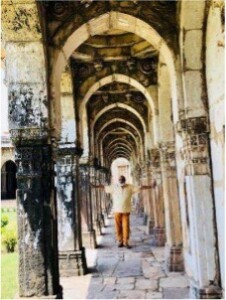 The next day I went to his house to see the drawings he had made. I asked his family if I could meet him. “He died last night,” they said sounding happy that I had agreed to look after the site. I started crying; I had lost my mentor; they were smiling as I would continue his work. Putting 30 years to my promise, I was able to make Champaner-Pavagadh a UNESCO World Heritage Site; the first by an NGO (Heritage Trust) and its President Emeritus – myself!!
The mission was impossible. India was not interested in any of its priceless heritage monuments. UNESCO did not want to talk to individuals – they represented countries and want to interact with the Government of its member countries. On the other hand I tried to engage UNESCO to look into India’s incredible heritage. But the more I strived to make this happen, the more India expressed its interest in promoting the country’s industrial ambitions.
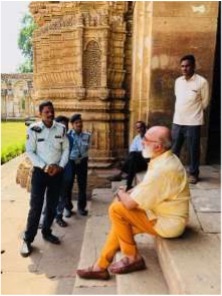 The Heritage Trust documented all the monuments – buried and above the ground. An initiative – the first of its kind in the world – “Children in Conservation” was started. Children cleaned the buildings under strict supervision and were made aware of the heritage they came from. The idea of the Champaner Festival was later initiated to introduce the inhabitants of Gujarat to come and experience the site. Persons like Mallika Sarabhai and Astad Deboo introduced the story in the narrative of their performances at Champaner.
We got President Kalam to lay the UNESCO plaque at Champaner. He requested us to suggest some principles that he could introduce at Rashtrapati Bhavan which we did. Soon it became a household name. The visitors went beyond those religious devotees who want to pay their respect to the Devi at the temple on top of Pavagadh hill. All buildings above the ground became accessible to visitors. The book “Myths and Legends of Champaner” lavishly illustrated by one of Baroda’s famous artist Jaidev Thakore was extremely well received and become one of the premier books on Heritage in India.
Compiled by Sonal Mithal Modi, Paintings by Jaidev Thakore, Photographs by Rahul Gajjar
In 2001, Heritage Trust received funding from World Monuments Fund, USA, to research and document the architectural monuments in the entire six square kilometer core area of Champaner-Pavagadh Archeological Site. The Trust gave this rather onerous task to conservation architects Sumesh Modi and Sonal Mithal Modi, both trained under Prof. Nalini Thakur from SPA, New Delhi. Team Modi set base at the Toran Guest House at Machi plateau, and began their detailed explorations of all the heritage buildings they could identify in all stages of preservation as well as disrepair and neglect that they could find on the Pavagadh Hill as well as the Champaner plain. It took them almost a year of measurements, drawings, photography and documentation to present to the Trust a fabulous manuscript of 114 monuments that they had found as against the ASI’s protection of 37 groups of monuments (covering less than 70). This documentation was the backbone of the dossier we created for Champaner-Pavagadh as India’s nomination for UNESCO World Heritage Site status for 2004.
But, while working on the actual tangible architectural and archeological heritage, Sonal Mithal Modi encouraged some of the team members to collect stories, popular and recounted over and over again, by engaging in casual chatter with the pilgrims, the elderly locals, the mendicants, the priests, the shopkeepers, the donkey-herders, and especially those selling small booklets, audio and video cassettes recounting the tales of Champaner-Pavagadh in words and songs. It was amazing – what they managed to get together, little gems of intangible heritage that had survived in oral storytelling. These wondrous stories — some imagined, some real, but mostly extraordinary — embroidered with the wisdom of ages blended elegantly with deliberate or mischievous dramatization!
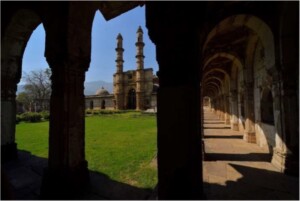
The Jama Masjid façade and corridor at Champaner, captured by photograpger Rahul Gajjar
We edited the stories, making them readable and crisp. But we also wanted to relate each story with a natural or manmade element at the site to establish that special relationship of the tangible with the intangible. So we selected only such stories and then further divided these stories into Myths (stories of Kali, Vishwamitra, Luv and Kush, Hanuman, of an age far, far, far back in mythical time), and Legends (stories of the Jain, Rajput and Sultanate rulers, from a historical age).
We then decided to make it into a form of a book. Now, came the difficult part – the stories were so remarkable that mere photographs of the places and spaces they represented would offer no justice at all to the power of the stories. An artist’s imagination would be needed here and I knew exactly who that artist would be – Jaidev Thakore. He could bring these stories alive with his bright colors, flat drawings and a quirky sense of humor. Karan Grover agreed with me, and sure enough, Jaidev turned out some truly delightful watercolors that mirrored the sentiment and feeling of the stories right away. The book was designed to fit the exact square size of Jaidev’s water-colors.
If Sumesh Modi’s documentation was the backbone of the dossier for UNESCO, Sonal Mithal Modi’s book, Myths and Legends of Champaner-Pavagadh, became the dossier’s soul. For in 2004, the importance of Intangible Heritage became one of the critical six key considerations against which a proposed nomination site would be selected. Champaner-Pavagadh won hands down.
The book was priced at Rs. 2000, and so sold slowly, but helped create a small fund to support the activities of the Trust. No copies are available now. Those who are fortunate enough to have a copy must know what a treasure they have!
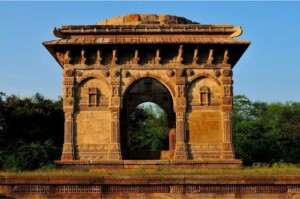
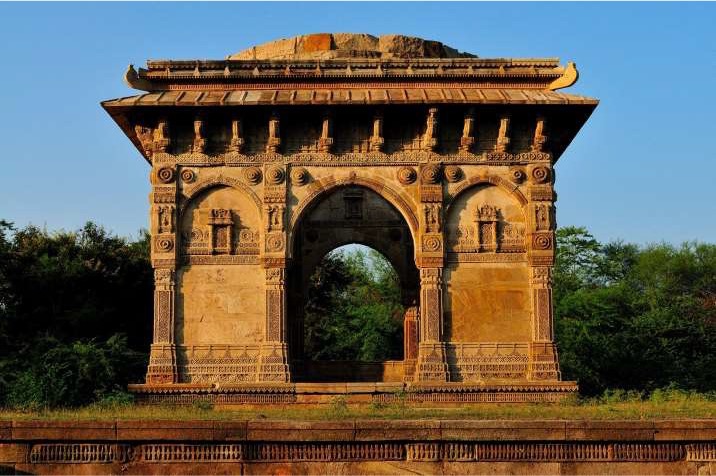
The Maqbara at Nagina Masjid, photography by Rahul Gajjar