
A Conversation with Dr. M.H. Mehta
- 7 years Ago
- 0 Comment
- 5 Min Read
Padmashri Dr. M.H. Mehta (Chairman – Community Science Centre and President of the National Bioshield Society, India) was kind enough to share his thoughts on the River Vishwamitri, its history, significance and revival. Dr. Munibhai’s knowledge and expertise on the subject is diverse and wide, spanning from the mythology of the river, to the conservation of the waterways built by the Mughals and Gaikwads to the creation of a natural bioshield to enable the Vishwamitri River to thrive and remain alive.
Here are some excerpts:
A few words on the historical significance of the River Vishwamitri.
The river Vishwamitri, mentioned since the time of the Vedas, is one of the oldest rivers in India. ‘Vishwamitrimahatmyam’, by Prof. Thakar, is an excellent resource book on the history of the river and was published by the Oriental Institute Vadodara in 1997. It recalls how according to mythology, it was on the banks of the river Vishwamitri that sage Vishwamitra was elevated as a Bramshri after reciting the Gayatri Mantra. The river was a part of the Shankara forest and this history makes one realize that without a forest the flourishing of the river is not possible. Vadodara has always had a very sacred relation with the river as is apparent from the number of revered places and temples and Ghats along its banks. Maharaja Sayajirao Gaekwad III envisioned Vadodara as a cultural capital and saw the river as a potential resource. Most of the city developed around the river. The river has a rich history. Evidence of water harvesting as well as the building of water channels during Mamud Begada’s reign display the role the river had to play in the development of the surrounding habitation areas.
How can a fragile ecosystem be preserved considering the explosion of developmental growth?
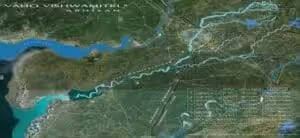
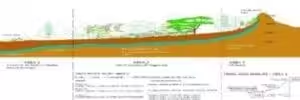
Is there scope for redefining the river and restoring it to its past glory? Revive and reconstruct the river front with plantation. The VVA, Vaho Vishwamitri Abhiyaan is a campaign that began with the social interest at large, which offers a scientifically organized security of the revival of the river Vishwamitri. The Abhiyaan aims to develop a bioshield starting from Pavagadh to the Gulf of Khambhat throughout the length of the river. This length of 134 kms can be roughly divided into 3 sections. 1. The hilly areas of Pavagadh 2. The flat plains of Vadodara and saline areas of Bharuch 3. – The 40km stretch of the saline area before the river drains out into the sea. For the revival of the river, this drainage area is most important, as for a river to remain alive it has to flow.
This creation of a bio shield means planting trees according the terrain alongside the river which will allow the river to live again by stabilizing the banks of waterbodies as well as reduce the erosion of soil along the banks of the river. The greening of the entire region from Pavagadh hills to the plains of Panchmahal, Vadodara and Bharuch with scientific biodiversity will not only beautify the region but act as the lungs of Central Gujarat. The bioshield along with water bodies will create a flow of clean water in the river throughout the year. In order to make this happen villages will need to manage their own solid and liquid wastes for which there is a proposal for all villages to have their own compost pits so that they are not forced to dump waste into the river. If we can catch 15% of the rainfall water, we would have 1.5 to 2 times more water than what Ajwa dam has. To make this happen, we need small check dams, catchment lakes and a bioshield comprising of 90,00,000 trees. Once accomplished, the river will be able to sustain its diverse ecosystem of birds and plants as it did earlier, as well be a water resource for the area.
 What do you think of the River Vishwamitri as a resource with multiple values like cultural, economic, environmental and social in the present day?
Unfortunately over the last several decades, the river has been degrading due to several factors. Unplanned urban growth, dumping of solid and liquid wastes as well as negligence changed the Vishwamitri. If revived, and restored to its old state, along with the development of the green belt, the river would provide water to the city. The beautification of the religious sites like temples and ghats would add to the heritage of the city and the areas around the river. The Vishwamitri is a part of Gujarat’s heritage which should be restored.
What can local citizens do to contribute to the preservation of the heritage of the Vishwamitri?
The Vaho Vishwamitri Abhiyaan is a community based participatory movement. In order to take care of the water body, the VVA engages the communities in the all aspects of the project. It is necessary for the members of the community to take care of the river as their own. Tree plantation is the important aspect of the VVA. Several Seed Ball Camps have been held by hundreds of school children and the seed balls have been dispersed at difficult to reach areas like hilly areas and ravines long the river banks. Hundreds of school children and citizens participate in these camps every year. Awareness of an integrated plan of ecosystem and water management needs to spread. The holistic model is the right model for this and we should implement it for the good of everybody.

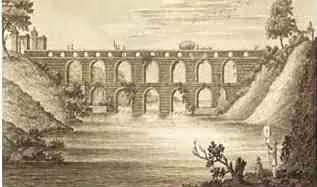
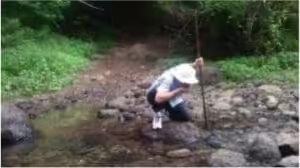
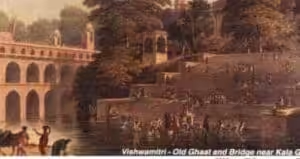
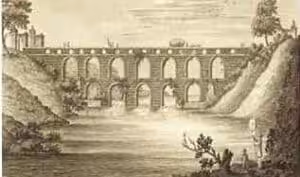
From top: At the river origin, its extent, Old Ghaat and Bridge near Kala Ghoda, Bio Shield, photo credits Dr. M. H Mehta