
Madhav Bagh – where the past meets the present
- 7 years Ago
- 0 Comment
- 3 Min Read
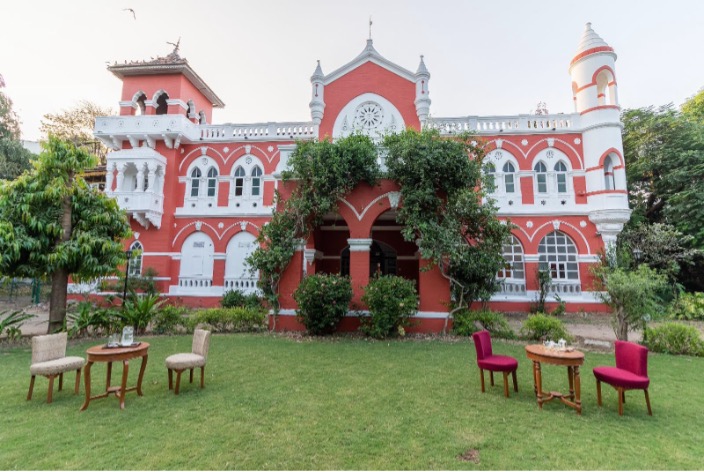
Madhav Bagh, a heritage residence in the city of Vadodara, has an interesting story to tell. Located in the centre of the city, opposite ONGC in Pratapnagar, Madhav Bagh is sheltered from the busy main road by its expansive grounds and trees. This regal mansion was the home of Madhav Rao Gaekwad, a cousin of Maharaja Sayajirao Gaekwad III. When Sayajirao was adopted before becoming the king, several of his relatives moved to Baroda with him. It is said that when Sayajirao’s father, Kashirao Gaekwad was offered land after it was decided to adopt Sayajirao, but he declined the offer and sought that his family should be settled in Baroda instead. Thus Madhavrao Gaekwad moved to the city with his father Gabajirao. Currently Madhav Rao’s descendant, Shivraj Gaekwad (5th generation) and his wife Indrayani Gaekwad continue to reside here. While the owners reside in the upper part of the building they have restored the ground floor and converted into a Heritage home stay.
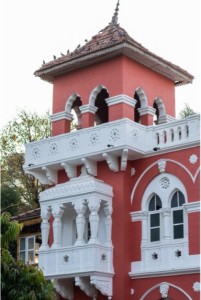
Built in 1892 in the Indo-sarcenic style possibly under the guidance of the architect Robert Chisholm (the architect of the Laxmi vilas palace,) on 1.5 acres of land, Madhav Bagh is an example of the architecture of that time. It boasts of an impressive red and white façade and the building is complete with arches and spires, motifs and carvings and Gothic turrets and jharoka style balconies. Indo-sarcenic architecture is a revival architectural style used by the British in the late 19th century for government and public building and palaces in the princely states during the British Raj. This synthesis of Mughal – Indo architecture was also an effort by the British to display that despite being an Imperial power, the British in India were a part of the Indian milieu. Yet this mixture of architecture remained British in spatial organization and composition as seen in the Laxmi Vilas Palace.
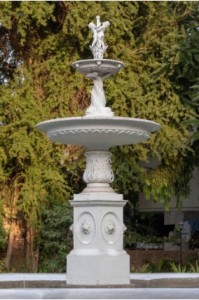
 On entering the grounds amidst the tamarind and mango trees a 200-year-old fountain from W. Whiteley, London, stands regally in front of the entrance. The ground floor which comprises of the home stay consists of 4 bedrooms, each which lead to an open courtyard, a dining and sitting room as well as several common indoor and outdoor sitting spaces. Several aspects of the superiority of the architecture of that time are visibly evident like the intact wooden girdles on the ceilings and the 18” thick brick and lime walls. Interesting facts related to the structure and construction of Madhav Bagh were discovered during the process of restoring and renovating the lower quarters. For example, the 10” diameter drainage pipes used during the time of construction are still working and run beneath the floors of each the rooms opening to a septic tank outside the mansion and there was a layering of bricks just beneath the stone flooring of the rooms. Though restored, Madhav Bagh has retained all of its original structure.
 The ground floor of the mansion was the office of the Archaeological Survey of Indian from 1975 to 2001, after which it was rented out to companies like Novena for a few years. Among the umpteen heritage buildings the city has to offer, Madhav Bagh is one that is now open to the people. Restoring the ground floor of this Heritage residence and opening its doors to guests from the end of 2018, Madhav Bagh gives one a chance to experience the regality of royalty.
Aarti Desai
- 4 years Ago
When we at Heritage Trust first planned doing Walks in and around Baroda, our attention, rather obviously, focused on the Walled City. We were not...
- 6 years Ago
(Disclaimer- Taking the conversation to an academia-oriented outlook, the column is an excerpt from the author’s work looking at cultural geographies and the role of...
Stepwells are wells or ponds in which water is reached by descending a set of steps. They may be multi-storied, with the use of a...