
Kamati Baug: A public space for community and cultural exchange since 1879
- 6 years Ago
- 0 Comment
- 5 Min Read
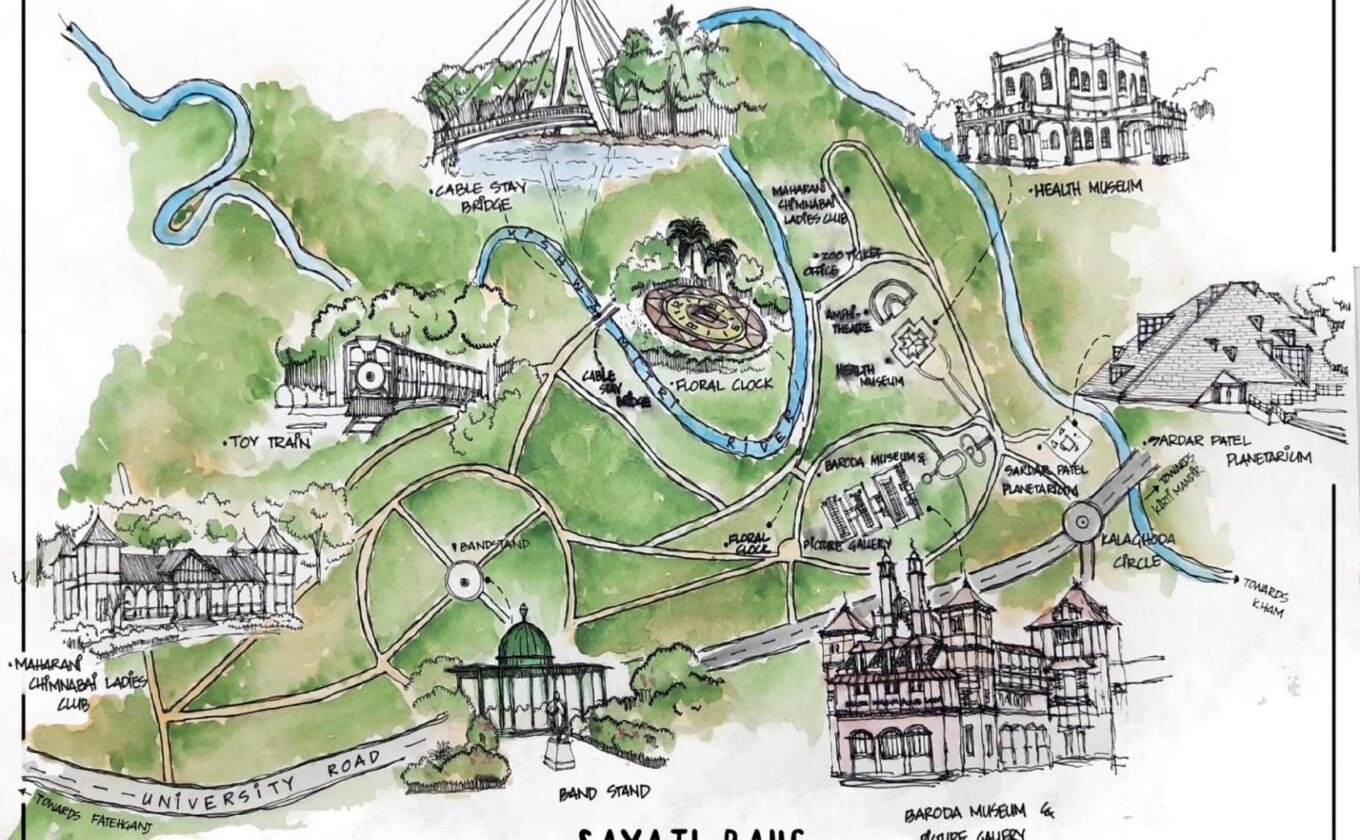
Baroda State was considered one of the most progressive states and the credit for this goes to the vision and foresight of one of its most iconic rulers, H.H. Maharaja Sayajirao Gaekwad Ill. The noteworthy development in the diverse fields of education, judicial, agricultural and socio-economic reforms laid the foundation for the modernization of the city. Being a Maratha ruler of a Gujarati state, Sayajirao Gaekwad Ill made several efforts to build a vibrant and cosmopolitan population. Engaging communities, educating and exposing them to the best facilities and faculties available, was part of Gaekwad’s manifesto. Apart from promoting education by the means of establishing schools and institutions, the Maharaja also understood the importance of cultural education, which was meant to reflect not only upon one’s own culture but to learn and appreciate the culture of others. The creation of a public space like Kamati Baug, to promote cultural education is proof of this ruler’s incredible ability to assimilate and adapt various elements to create a unique combination of form and ideas for the benefit of his people.
This large public park, often called Sayajibaug, was the Maharaja’s gift to the state of Baroda. The garden is probably one of the earliest and most accessible of the many public spaces created by the Gaekwads. Commissioned in 1879, spanning over an area of 113 acres, one of the largest in western India and located in the centre of the city, Sayajibaug enabled the Maharaja to bring the aesthetics of western art, and knowledge of the sciences within the reach of the common mans reach (something which otherwise was accessible only to the wealthy and the educated at that time).
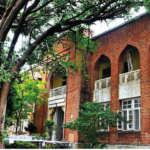
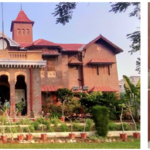
Sayajibaug is home to a zoo, a planetarium, the Baroda Museum and Picture gallery, a cable suspended bridge, a miniature train, (now replaced by a larger toy train)an amphitheatre, a huge floral clock and several beautiful fountains and bronze statues dating back to the time of Sayajirao Gaekwad Ill. Though the amphitheatre and planetarium are more modern additions to the garden, the original suspension bridge was built at the same time as the garden, by the John Fleming and Co. Engineers, Bombay using European technology. This modern looking structure is said to have been damaged in 1965, and in 2016 the present bridge was constructed on the lines of the original one. Also in Kamati Baug, standing till today is the Maharani Chimnabai Ladies Club. This interesting building was also called the mobile palace as it was moved to Delhi in 1911as the Maharaja’s residence and then was moved back to Baroda.
The Baroda Museum and Picture gallery commissioned in 1887 designed by Robert Chisholm and Major Mant, on the lines of London’s Victoria and Albert Museum. It was completed in 1894 but the Picture gallery was completed in 1914 but opened much later in 1921due to a delay in the procurement of artworks from Europe because of the World War I. Built in 1878, the building housing the Health Museum was used as a guest house accommodation for the royal guests. Though the Baroda museum houses an impressive art collection, the neo-classical figures and numerous urns and vases on public display, around the Bandstand area, are incorporated into the very design
of the garden. The Bandstand serving for a venue for live music for the public was an ideal location for these statues. Executed by Ganpatrao Kashinath Mhatre (1934), one of the most successful sculptors in colonial India, is the notable equestrian figure of Shivaji, installed south of the Museum. With an attempt to blend the western aesthetic with Indian sensibilities, the only other Indian figures to be seen are two statues of The Brave Boys of Dhari; these sculptures are tribute to the bravery of two village boys fromAmreli, Hari and Arjan Koli, who put up a fight against a tiger during a hunting expedition of Sayajirao Gaekwad Ill, presumably saving the king’s life.
The lungs of the city, Kamati Baug, emphasizes not only the importance of green spaces but serves as a place of learning through the variety of flora and fauna seen here. In the Bandstand area, supporting local biodiversity, there are seven Andrakh trees, of which the oldest is approximately 120 to 140 years old. Many Asopaloav trees opposite the Rinchhkhana are approximately 134-140 years old and a massive Neem tree near the lion enclosure in the zoo is estimated to be over 120 years old. Apart from these, a couple of Haldu/Haldarvo trees, a Shimlo tree near the Commissioners bungalow and the Modal tree all over 100-110 years old are native trees and found in naturally growing forests and their presence indicate that they were not disturbed during the planning and development of the garden. Though urban public parks have always been an important setting for cultural programs, this garden, has been encouraging community engagement for over a hundred years, and continues to do so till this very day, Kamati Baug functions not only as a conscious tool for learning and revitalization but helps to define the shape and feel of the city.