
Role of Museums in Enriching the Society
- 5 years Ago
- 0 Comment
- 5 Min Read
The Oxford Dictionary describes museum as “a building in which objects of interest or importance are stored and displayed”. For the common people, the prime function of the museum is usually considered to be the preservation and display of artefacts of archaeological and historical interest. The majority of museum visitors are unlikely to give a thought to the wider role of museums in society. However, from my personal experience, when asked, the museum goers generally opine that museums are worth to visit.
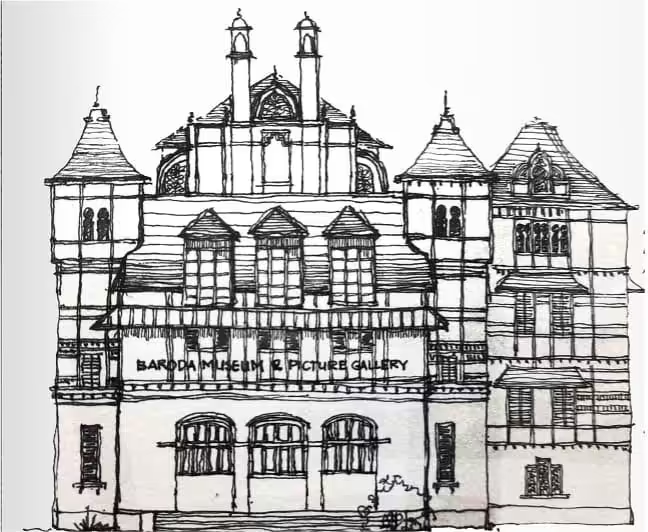
For children, museums are viewed as sites for exposition and as repositories for preserving valuable, unique and unusual objects of the past. A nine-year-old child from Baroda, was asked about her reflections on museum and her response was; “museums preserve mummies and stuffed animals and skeletons and are kept for public viewing as we could see in Baroda Museum and Picture Gallery.” This view reflects the preservation, exhibition and collection missions of the museum. In this light, if we look back to the year 1870, the Metropolitan Museum of Art, New York founded with a proposed mission that, “the new institution not only cultivate a pure taste in all matters connected with the arts, but also provide the people of New York city with a “means for innocent and refined enjoyment”. When we see the situation in Europe, the South Kensington Museum later termed as V&A, kept its doors open during the evening hours for the common man to visit and enjoy. The conversion of the Louvre from a palace to a museum in the immediate years after French Revolution indicated its multiple manifestation in purpose. At present, a museum is no longer only measured by its internal possessions such as collections, endowments, staff and facilities, but by ‘an external consideration of the benefits it provides to the individuals and communities it seeks to serve’. Luke (2002) opines, “Museums possess a power to shape collective values and social understandings in a decisively important fashion”.
Scholars in the field of Museum describe museums as “living institutions” (Spalding 2002) which are constantly changing and regularly revisiting their purposes. Of late, the significance of museums as social institutions to serve society has become more relevant to significantly position itself within the social rubric.
While exploring the role of museums in enriching society, innumerable dimensions, right from their existence to extension can be elucidated. The museum is the social space for interaction, gathering, dialogue, discussion, performance, display, education and enjoyment. The people who visit the art museums generally look forward to enjoy the timeless beauty of the classical artworks in relaxing environments which promotes ”reflection, contemplation and discussion”. For the teachers and student communities, the museums act as a supplement for the formal learning offered in schools and colleges and also as a “symbol of lasting value”. With regard to accessibility and inclusion, museums are slowly evolving as the spaces for the physically challenged, visually impaired, mentally and emotionally challenged, special segment of the society. Museums are adopting various ways and means to recreate its galleries and spaces in order to facilitate visitors with down’s syndrome, autism and similar other special segments of the society who needs attention.
All over the world, museums are continuously evolving in their role, functions and services and have started welcoming the community to participate in actions and activities whereby community engagement and participation becomes the core function of the museums. Museums are trying to learn what the community needs and further fit the museum ideas and activities to those needs so as to make the museums as a social entity relevant to the community and society. The museums in collaboration with community take initiative to co-create and co-curate exhibitions enabling them to tell meaningful stories to the public through the lens of the community perceptions, which are more appealing and acceptable.
With the application of digital and information technology museums attempt to reach out to the society and public. Through this effort the museum collections and spaces become more accessible to those who cannot otherwise reach museums due to various barriers. To cite an example, museums in UK provide educational services by conducting video conferences with schools and thus reach out to larger number of young children. The museum studios are used to communicate and transmit the shows by using methods of demonstration, storytelling, enactment, puppetry and many more. The Museo buses and vans otherwise called as “museum on wheels” goes to the community with a view that, “if the people cannot come to museum, let the museum go to the people.” An excellent example is the Museum Bus by the Chhatrapati Shivaji Maharaj Vastu Samgrahalaya, Mumbai and many museo-buses operated by science museums under national science council museums of India. The regional science centres through their mobile museo buses reach out the unreached, the rural people and provide scientific information and updates.
To conclude, museums keep evolving and changing their role in serving society as informal educational institutions and community participatory spaces while trying to make themselves vibrant and their presence felt. They keep reaching out to people and the symbiotic relation and collaborative events should take the museums to further heights in the days to come in serving the public and the society. In the near future, museums will continue to evolve in its role and application and services through the application of information technology, virtual reality, augmented reality and artificial intelligence. Application of technologically advanced gadgets and social media platforms will enable the museums to create their identity and maintain the same and create a far-reaching impact in times when museums are expected to be more responsive towards their audience and roles they play in society.
Dr. Ambika Patel
Head, Dept.of Museology
Dean of Students, Faculty of Fine Arts
President – ICOM India
Reference:
Luke, T.W., . 2002. Museum Politics, Minneapolis. University of Minneapolis. Spalding, J. 2002. The Poetic Museum: Reviving Historic Collections, New York.