


- This event has passed.
Mandvi Gate, Vadodara: Safeguarding a Living Monument of History and Identity
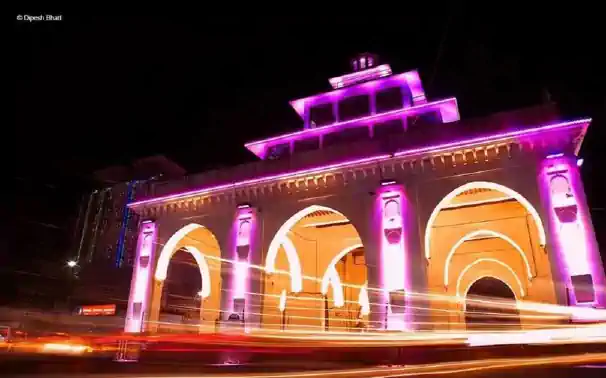
Mandvi Gate, located at the centre of Walled City of Vadodara, is one of the most enduring monuments of the city’s heritage. Constructed in 1511 under Sultan Muzaffar Shah II, it originally functioned as a central pavilion to collect tax (octroi) from traders passing by at the crossroads of the four principal streets in the fortified town. During the Gaekwad rule, the gate was expanded with additional storeys and ornamentation. The upper stories were initially built in timber, but at a later stage they were replaced with reinforced concrete, which altered both the load behavior and the character of the structure. In 1856 Ganpatrao Gaekwad introduced a clock, further establishing Mandvi Gate as the civic centerpiece of Vadodara. Its distinctive combination of Islamic arches, Maratha detailing, and colonial-era interventions reflects the layered cultural identity of the city.
The conservation of such a complex and historically significant monument requires careful planning. The process begins with documentation through photographs, condition mapping, and drone survey to capture details of inaccessible areas. Stabilisation measures, such as propping, are introduced at the earliest stage to prevent collapse. Foundation inspection is equally crucial, as the manhole of the main drain passes close to the base of the most damaged pier, creating the risk of weakening from below. Laboratory testing of stone and mortar samples is used to design compatible repair materials. Structural strengthening typically includes lime-based grouting to consolidate the masonry core, stitching of cracks with stainless steel helical bars, resetting displaced stones and bricks, and replastering with breathable lime mortar. All interventions must be coordinated through a Detailed Project Report (DPR), which provides a roadmap for conservation. A DPR records the historical background, documents damage through photography and drone imagery, includes structural analysis and laboratory results, details methodologies for repair, sets out cost estimates and timelines, and outlines a framework for maintenance and monitoring. This ensures that conservation proceeds in a structured and transparent manner.
The declining state of Mandvi Gate has drawn significant attention in recent months. The Heritage Trust of Vadodara has become actively involved, recognising the urgent need to safeguard the structure and initiating dialogue with both local authorities and technical experts. On April 20, Her Highness Maharani Radhika Raje Gaekwad, accompanied by Sameer Khera, Nimish Makadia, and the Helifix team, visited the site and emphasised the need for immediate action. Shortly after, on April 24, a team of structural experts from Mumbai inspected the monument, and their formal report, submitted on 1 May, confirmed the seriousness of the situation.
The assessment revealed that the mortar between brick joints had deteriorated to a powdery state, causing instability in several courses. Vertical and diagonal cracks were traced across critical portions of the structure, while stone elements at the base showed signs of crushing under load. Temporary steel props had been installed as a protective measure, but the experts warned that these could not substitute proper structural intervention. The report made it clear that failure was likely if timely repairs were not initiated. By late August 2025, the condition of the monument had become more alarming. Large areas of plaster had fallen off, exposing fragile masonry. Bricks were loose in multiple zones, cracks had widened, and pieces of stone had detached from the base.