

Nothing speaks more about a city than its history and people. Connecting the population of an ever growing metropolitan, the city’s temples are symbols of not only spirituality but also of the community and culture. While temples serve as a community centre of worship, a sacred destination, they also become a landmark around which ancient arts, community celebrations and economy flourishes.
Not only does Vadodara have several popular places of worship like the EME temple and the Isckon temple which are on the list of tourist spots; but the city is home to several historically significant temples too. Dating back to the 19th century, there are some beautiful temples like the Dhundiraj Ganpati Temple in Wadi, the Tarkeshwar Mahadev Temple at Sursagar, the Kamnath Temple on the Ghats of Vishwamitri, the Surya Narayan Mandir near the General Post office, the Amba Mata mandir in Mandvi and the Kubeshwar Dutta temple in Kirti Mandir, each standing tall with a story to tell.
Dhundiraj Ganpati temple: Located in the Wadi area of the old city, The Dhundiraj Ganpati Temple was built during the Gaekwadi era by Gopalrao Mairal, a Sardar in the erstwhile Baroda State. This temple is also known as Mairal’s Dhundiraj Ganapati Temple.
This 176-year-old Ganpati temple is a unique blend of Maratha Wada and Gujarati temple architectural styles. Though no longer as majestic as it was in its full glory, this serene temple retains several aspects of its old grandeur. To go in the temple, one must enter a three storey building which houses the shrine. The vahana of Ganpati, Mushak, normally positioned at the feet of the deity, is placed on a pedestal, outside the shrine, facing Lord Ganesh. Idols of the two wives of Lord Ganesh, Riddhi and Siddhi flank the marble idol. The wooden carvings and pillars of the temple display the unique style of carving that is similar to that seen in Tambedkar Wada. It is said that the temple was constructed by labourers from Rajasthan, Mumbai and Hyderabad. Till date the Mairal family continues to be the caretakers of this private temple. Story goes that there lies hidden treasure beneath the fountain of the temple!!
Tarkeshwar Mahadev Temple: On the northern bank of the Sursagar Lake, the Tarkeshwar Mahadev temple was built in memory of Maharani Jamnabai’s daughter, Tarabai, who died at a young age. Maharani Jamnabai, the wife of Khanderao Gaekwad, gave birth to Tarabai shortly after the demise of her husband. With the birth of a daughter, it was Malharrao who was crowned the king. But in 1875, after a 5-year rule comprising of bad leadership and tyranny, he was exiled to Madras and Gopalrao, better known as Maharaja Sayajirao Gaekwad III was appointed the ruler of the state.
Near the Sursagar lake, tucked away in a courtyard in the midst of trees, this temple offers serenity in the middle of the bustling city. In order to reach the temple, one has to pass through a bustle of shops and if you don’t know where to look you are most likely to miss this temple. Built in the south Indian style of temple architecture, the temple is built on a high plinth and has a sabha mandap and garbha griha which is crowned on the exterior with a shikhara. As with the other Shiv temples in the city, the month of Shravan sees devotees throng the temple on the auspicious Mondays. Shivratri also is celebrated in a big way at this temple.
Like many ancient monuments, old temples like these form a significant part of our heritage. Though they remain a testament to the living heritage of a city and continue to enjoy the patronage of the public, it is now necessary to consider their preservation, as each has a story weaved into history, to tell.
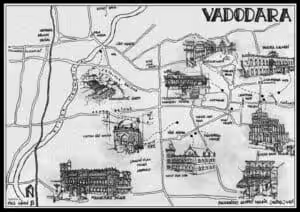
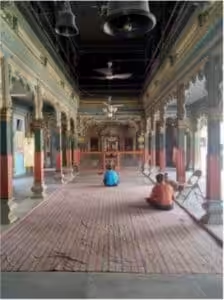
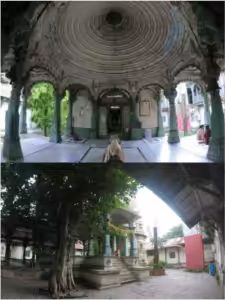
Image Caption:
(Top) Mapping of some of the hidden spaces in our city east to the Vishwamitri;
(bottom Left) Inside the Dhundiraj Ganpati Temple. Source: Shivani Pikle;
(bottom right) Tarkeshwar Mandir inside the mandapa and the Wada around it. Source: Krishna Shah